Mixing optical kill and Telemetry might be bad news…

I consider myself to be a fairly knowledgeable guy when it comes to electrical systems in RC airplanes.  Batteries, chargers and basic servo mechanisms and the like don’t frighten me.  I can solder a good joint, extend servo wires, create a voltage drop harness with a diode… no problem.  I don’t pretend to fully understand spread spectrum radios, short of an RF engineer no one really does but I feel I’m at least a fairly educated user and understand it well enough to cover the basics and have a fairly intuitive grasp on how to safely deploy the new technologies.

But, sometimes I push the envelope and try to make full use of multiple “new” technologies and bad things can occur.  Hey, if you don’t push the limits a little bit you will never learn anything new.  Add the reluctance of manufacturers to fully explain and publish information on how their technology works and occasionally we enter that part of the world that should be labeled “Here there be Dragons”.

Recently, a friend who relies on me to help him deploy the newer technology had a bad result with his Giant Scale P40.  We had setup the Spektrum telemetry system in his bird to provide (amongst other things) RPM readings.  We had done this by using a Y harness from the hall sensor on his DLE ignition.  In this same bird we had put in place one of the many brands of remote kill switches that is marketed as an optically isolated system but had used power from the same battery that powers his receiver.  In testing all seemed OK but we started to have issues with this configuration where the optical kill did NOT cause the airplane to shut down.  Back to the drawing board it appeared it might be possible the ignition was drawing power through this kill.  We swapped the kill to insure it was not failing and had the same result so we then tried eliminating the ground wire on that connection.  This seemed to help and we went merrily on.  We then went on to replace the engine on this bird to give it a bit more pull.  Shortly thereafter the plane started to die during flight and during one of these flights the dead stick did not go well and the plane was destroyed. While it is certainly possible it was something more basic like a bad servo extension etc… it seems as if this RPM sensor connection had some play in the crash.  The engine quit like a switch was being shut off, not like it was starving for air or fuel.  Plus test stand runs after with a much simpler electrical system worked flawlessly!

Eliminating the Telemetry on the test stand afterwards seemed to eliminate the problem and I can’t help but think it has something to do with this combination of Telemetry and ignition kill that caused the issue.  In the future, I think I will avoid using both and will either deploy a second battery for ignition, eliminating the optical kill or at least feeding it off a separate source entirely, or we will not deploy the RPM sensor (at least not by connecting via the hall sensor).

Please note I am not blaming either Spektrum or the kill switch manufacturer for the issue.  Using the halls sensor connection is not an approved method to make this happen… though some folks have made this work.  I will continue to pursue a better way to get RPMs working along with the use of an IBEC which is now my preferred method of running my ignition.  I have the magnetic sensor deployed on my DA 50 powered mustang and it doesn’t cause any issues but can also give erroneous high readings on occasion in mid flight so the search goes on for a better mouse trap!  I’d love to take advantage of the RCEXCEL RPM tap off of the ignition.  If anyone has ideas about how to make use of that to feed the Spektrum Telemetry I’d love to hear about it.  If I make progress on this, I will post and let you know.

In the meantime I’d discourage any use of the ignition hall sensor connection as a way to monitor RPMs, at least when you are running a single on board battery system and maybe just avoiding it all together is better.


Two P51 flights Saturday at the field

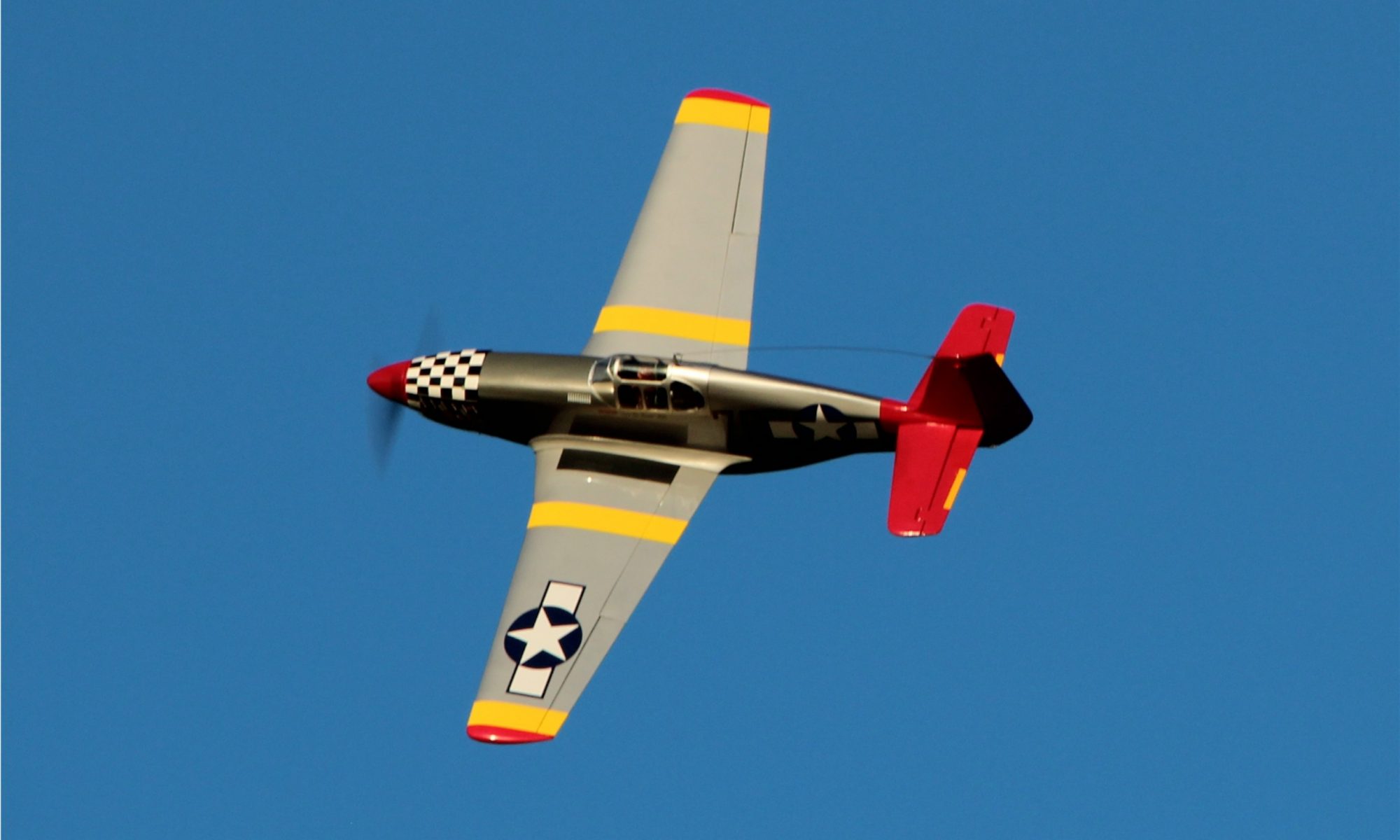
Though I’ve flown the Top Flite giant scale Mustang a half dozen or so flights in the past, yesterday was the first time since I swapped in the Power safe receiver and moved it over to the DX-18 that I’ve had it in the air.  It was a sort of second maiden flight.

All in all, the weather was just about perfect once a rain storm cleared.  The wind was almost zero and the temps were in the high 70s.  The plane seemed to fly well with only the landing being a bit tricky because my flap mix resulted in a marked nose down pitch.  This meant that I could land without flaps… something I don’t recommend as the plane requires a fair amount of airspeed to fly… or with flaps while constantly holding in some up elevator to compensate.  I chose the “with flaps” option and managed to get it down with only a minor bounce or two.

I decreased the flap mix a bit after the first flight and tried again, this time getting in some knife edge flight and some high speed, relatively low passes with good results.  It appears I could use some more rudder throw and it was programmed for triple rates but I was unsure of my switchology and this was not the time to start flipping to find it so I will try some higher rates on the next flight once I am confident of which switch does the trick.  When it came time to land I found the same issue as before, though not as bad.  I will reset the mix to put in some up elevator for the next flight and see how that works out.  I guess this plane requires up elevator mixing with the application of the flaps instead of the expected down trim to prevent ballooning.  Looks like the drag wins out over the increased lift in this case.  Again the landing was at least “not damaging” but the rain was threatening so we packed it in for the day.

Today, upon recharging the flight packs I found they took 183 and 249 to top off the starboard and port packs.  Between the two flights this was about 12 minutes of flight time so it seems to take about 35mah per minute of flight.  With two 2300 LiFes on board and an average 10 minute flight…. well I don’t think I’ll worry much about charging between flights if I come with full packs!  I can monitor the idle and in flight voltages via the Telemetry system but will eventually likely need to rig a way to monitor the flight packs “at rest” at some point in the future.

Telemetry tells me I hit almost 4 Gs positive and 1 negative during these flights with a max airspeed of about 85 mph.  Temperatures on the motor stayed in the range of about 200-230 degrees (F) once it was warmed up, which seems to be a fairly normal range from what I’ve seen so far.  Static RPMs hit almost 6000 with the 22×10 Xoar but showed over 10,000 in the air.  I can’t really believe that is occurring… must be some sort of telemetry glitch.  I’ll eventually have to look into that to see if I can figure out a way to refute that and fix or at least explain that odd readings.  I plan on flying the Mustang again soon in preparation for our club Airshow coming up on July 28th.  I’ll try to post more as I get some more time on the airframe.

My P-51B Top Flite Giant Scale Mustang

This post is just to cover the basic stats of one of the larger planes in my fleet.

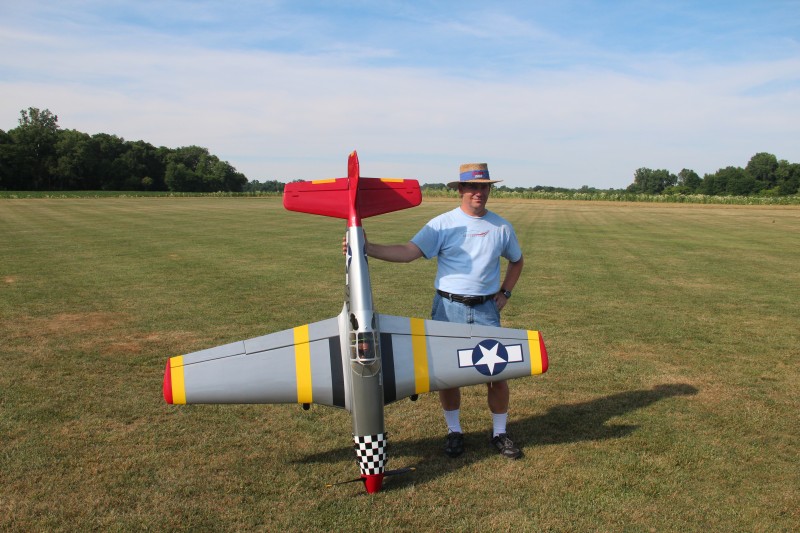
Here’s a pic of me with my P-51 at the Indianapolis RC Modelers’ field in Morristown, IN.

IMG_1750

Here are all the facts and figures for those who care:

Top Flite Giant P51D Mustang ARF…  Converted to a B model.

WS 84″.5  L 73″

Weight ~21 lbs

11 servos – Hitec 645s, Hitec 7955s

DA-50 with Keleo scale exhaust

JR 12 DSMX powersafe receiver

Batteries are 2 A123 2300mah for the receiver with BEC for ignition

TM1000 Spektrum Telemetry module with:  3 axis 8 G sensor, Altimeter, Airspeed Sensor, Temperature Sensor (engine), Receiver voltage, Ignition voltage, RPM sensor

Spektrum DX18

Vinyl Stars and bars, nose art, pilot name – BandE Graphixs

Body was stripped, converted to the B then glassed before I got it.


Approximate Cost

Airplane $400

Motor $300

Servos $400

Batteries & switches $150

Telemetry $300

Rcvr $200

Prop and spinner $75

GI Joe, panel, etc $50

Fuel tank $50

Servo extensions $50

Covering 2 alum, 1 yellow, 1 red, 1 flat grn, 1 fly black -$75

BandE Graphix – $100

~$2150 total


FlyZone Beaver – Update #2

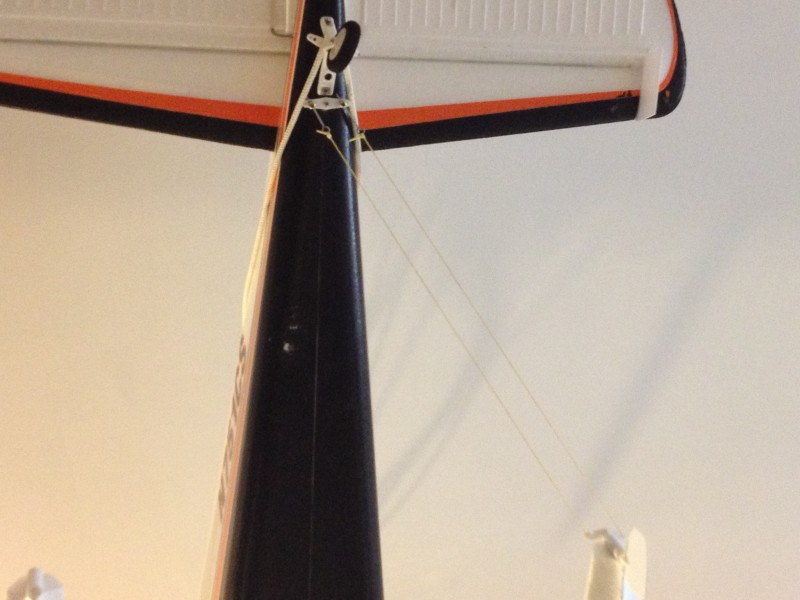
Spent a little time looking at the water rudder connections and decided to just eliminate one rudder… never needed more than one on any other float plane… then do a standard pull-pull connection to the other.  It’s all rigged now.  Looks like this:


Re-rigged water rudder on the FlyZone Beaver.


Kept the eyelets on the end for adjust-ability and used Kevlar thread for the runs just because I had a small amount on hand that was probably not enough for anything much larger.  I haven’t tested it yet so will have to get back with update #3 with a report after a field test… or is that pond test?

FlyZone Beaver – Update #1

Just a quick update with thoughts after float flying the FlyZone Beaver.

The plane does fly well off of water and looks great in the air with the floats attached.  But I continue to find shortcomings that make me wish for a bit more refinement from FlyZone.

In this case its the water rudders that have me irritated.  No two ways about it, the linkage mechanism with the rubber bands to return them to center is just a bad design from square one.  They are impossible to get to center well and especially to do so repeatedly.   The rudders will turn sideways and drag in the water (of course only one at a time) causing uneven drag and unexpected turns.  I usually say a water rudder is a necessity for float planes but I’m tempted to disconnect these permanently.  Maybe I can rig a pull-pull cable system for one and remove the other….  its worth a try because the system as is… is just crap.

The plane is not particularly overpowered either so taking off does require some time using the water rudders.  It’s not terribly underpowered either, unless your dragging a sideways rudder through the water on takeoff!

In case you are wondering, while at the Nall recently I was camped next to two guys who both had them and they had the same issue with the water rudders… it isn’t just me!

I will continue to fight this problem so if I come up with an acceptable solution I will post again.  With the money invested and the space it takes to haul this plane around with the wings attached permanently (for all intents) I have to at least make it into a good float flyer so it won’t become a total hangar queen!


Changes to the 50cc Slick… Gas tanks and propellors

My WildHare Slick with DLE-55 power has always been a great airplane to fly.  This is my second one and I have learned a lot since I flew one first about 5 years ago.  As I learn more about mixes, balancing, setup, etc… I continue to make minor changes both for performance and to suit my own preferences.   The most recent changes are a new Falcon 23×9 CF propeller and a new fuel tank.  First I’ll talk about the tank and the reasoning behind it.

I had noticed that with all the other setup at least in the ballpark, I could not set my elevator to have enough throw to get a clean break in my spin entries AND at the same time keep it from snapping out if I pulled a tight loop.  A friend of mine pointed out that this could be because the plane was to nose heavy.  That seemed plausible as I have a tendency to setup my aircraft that way.  I’m leery of getting into a tail heavy setup as that makes the plane to sensitive and jerky on the sticks.  Doing some quick flying checks it did appear I was even more nose heavy than I normally fly so I started looking to remove some nose weight or shift it back.

I’ve never been fond of the standard tank setup in these gas birds as the tubing hardens or softens over time (depending on what type you use) so I had gone to a RotoFlow tank which has internal brass tubing with a heavy clunk that rotates in the back of the tank.  A couple years of use has proven they are really very nice systems.  The problem in this case is the tank is in front of the balance point and therefore contributing to the nose heavy issues.  The one problem with these tanks is that they are heavier than about any other setup.  I have a 24oz tank in my Slick which is really far more than needed if  you have a reliable pickup system… which it does.  That means I could stand to use a smaller tank as well… more weight savings from the tank material as well as carrying less fuel would lighten the plane and shift the balance.  Just what the doctor ordered.

I looked around and saw that many folks (especially the 3D crowd) had gone to what I call the “water bottle” tanks.  They are made of extremely thin (and therefore light) plastic like most water bottles are now.  Though I would be going back to the tubing that will likely harden and necessitate replacement every so often, this is less of an issue since the tank is so easy to get to in this airplane.  I found a nice 20 oz bottle from the good folks at B & E Graphix which is preassembled with a nice felt covered clunk and installed it with a savings of about 4 ounces in weight plus carrying 4 liquid ounces less fuel for a nice overall weight savings.  This is just in front of the wing tube so won’t be a big balance change but every little bit helps and overall weight savings is good as well.  For around $17 it seemed like a pretty good deal.

http://bandegraphix.com/products/product_images/tank%2020oz.jpg


The second change I made at that same time was to swap my Xoar 23×8 Laminate for a Falcon 23×9 Carbon Fiber.  I broke one of my Xoar props recently when a taxi with tailwind turned into a “nose stand” maneuver :-(.

I had heard good things about running one of these with a DLE-55 (which is what I run) and was assured by the vendor that even with my canister (Proflow… it has been excellent so far) it would not drag my motor down any more than the Xoar does.  I get about 6200 with the 23×8 but the Falcon looks to be a bit thinner blade so the pitch may not cause as much of an issue.  Checking the weight resulted in good news.  The Falcon is 1-1.25 ounces lighter than my laminate Xoar.  This should help the nose heavy issue quite a bit being as it is weight that is about as far forward of balance as is possible.

After both these changes were accomplished I have done half a dozen flights and noticed my balance is much closer to neutral than before.  Still just a touch on the nose heavy side but by only a small margin which makes me very happy.  The Falcon gives me a bit more speed on the up lines and seems to still brake enough to keep the down lines from gaining much speed so all in all, an excellent choice of prop for my needs.  $70 is not what I’d call cheap but CF props never are!  I haven’t tach’d it with the new prop yet but performance seems fine in long pulls so I expect to see about the same RPMs as before.  Nicely in the lower power band of this motor and ideal for what I do with the airplane.

Overall both changes seem to have accomplished what I wanted.  I encourage anyone with similar desires to try these products out.  They seem to be winners.


Favorite Picture from Joe Nall 2013

This is a photo I took at the 2013 Joe Nall.  To me, it expresses pretty well what the whole event is about.

IMG_4554

Its about 7 AM as the sun is up over the tress.  Dew is heavy on the grass and an early morning fog is trying to burn off.  It’s a hazy but cool early morning in rural South Carolina.  Maybe 60 degrees now, but the air is heavy with moisture and it is definitely on its way to 85 and sunny later on.  Things are relatively quiet with just a few RC planes cruising in the haze.  Most folks are sitting around their camp sites planning the day and having some breakfast.  Looking out from my campsite situated just north of the Electric flight line… this is what the morning looks like.  A young man about to get his first flight of the day is almost silhouetted against the bright morning sky.  From the main flight line to my North a large gas powered biplane passes overhead.  The start of another beautiful day at “The Nall”.